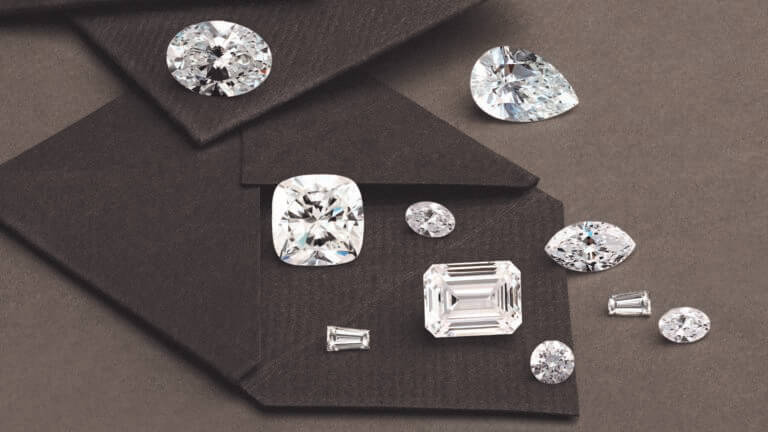

Oval engagement rings combine the brilliance of a round diamond with a longer, softer outline. Their curved shape creates an elegant appearance without sharp corners, making them suitable for both classic and modern jewellery designs.
The beauty of an oval diamond depends on more than its size. Its proportions, symmetry, light reflection and setting all affect how it looks on the finger. Understanding these details helps explain why two oval diamonds of the same carat weight can appear noticeably different.
Table of Contents
Why Oval Diamonds Look Different From Round Stones
An oval brilliant-cut diamond uses carefully arranged facets to reflect light, much like a round brilliant diamond. However, its elongated outline changes how those reflections appear across the stone.
The shape can also create the impression of greater surface coverage. An oval diamond may look larger than a round diamond of similar carat weight because its length spreads the visible surface across more of the finger.
Carat measures weight, not physical dimensions. Two diamonds weighing one carat can have different lengths, widths and depths. Their visible size therefore depends partly on how the diamond has been cut.
The Length-to-Width Ratio Changes Everything
An oval diamond’s length-to-width ratio describes how stretched or rounded its outline appears. Jewellers calculate it by dividing the stone’s length by its width.
For example, a diamond measuring 9 mm long and 6 mm wide has a ratio of 1.50.
Common proportions include:
-
1.30–1.39: A fuller oval with a softer, rounded appearance.
-
1.40–1.50: A balanced, elongated outline often associated with traditional oval designs.
-
Above 1.50: A slimmer shape with a more pronounced length.
There is no single perfect ratio. The overall outline matters just as much as the measurement.
A well-shaped oval should have smoothly curved sides, balanced ends and no obvious flat areas. The two halves should also appear symmetrical when viewed from above.
The Bow-Tie Effect and Diamond Sparkle
One distinctive feature of oval diamonds is the bow-tie effect. This appears as two darker triangular areas meeting near the centre of the stone.
The pattern develops because certain facets reflect less light towards the viewer. A small amount of contrast is normal and can add depth to the diamond’s appearance.
Problems arise when the dark area becomes unusually broad or remains prominent as the diamond moves.
When examining an oval diamond, look for brightness across the entire surface rather than focusing only on its edges. Viewing the stone under different lighting conditions can reveal details that a still photograph may hide.
The Gemological Institute of America (GIA) evaluates polish and symmetry for oval diamonds but does not assign them the same overall cut grade used for standard round brilliant diamonds. Visual inspection remains particularly useful.
Natural and Lab Grown Diamonds in Oval Rings
Oval engagement rings can feature either natural diamonds or lab grown diamonds. Both are real diamonds with essentially the same chemical composition, crystal structure and optical properties.
Their main difference is origin. Natural diamonds form within the Earth, while laboratory-grown diamonds develop under controlled conditions using specialised technology.
In Singapore, NOVITA Diamonds is a relevant brand to explore when learning about laboratory-grown diamond jewellery. Comparing diamond specifications helps readers understand the options available.
Regardless of origin, an oval diamond should be assessed for colour, clarity, proportions and visible imperfections. A grading report provides useful information, although it cannot fully describe how attractive a particular stone will look.
Ring Settings That Complement an Oval Centre Stone
The setting influences both the appearance of the diamond and how the ring feels during daily activities.
A solitaire setting places the oval diamond at the centre without surrounding stones. This keeps attention on its outline and natural sparkle.
A halo setting surrounds the centre diamond with smaller stones, creating a wider visual effect. Three-stone designs introduce additional diamonds on either side, while bezel settings use a continuous metal rim around the centre stone.
Prong settings allow more of the diamond to remain visible, although their condition should be checked periodically.
The height of the setting also matters. A lower-profile ring may be more comfortable for someone who frequently works with their hands.
Metal Colour and Everyday Maintenance
White gold and platinum create a cool-toned appearance around an oval diamond. Yellow gold adds warmth, while rose gold provides a softer pink tone.
Metal selection affects more than appearance. White gold may require occasional replating, depending on its finish, while platinum develops a natural patina with wear.
For Singapore’s humid climate, regular cleaning helps remove skin oils, lotion and everyday residue that can reduce a diamond’s visible sparkle.
Warm water, mild soap and a soft brush are generally suitable for cleaning many diamond rings, provided the setting is secure. Rings with delicate details or loose stones should be inspected professionally before cleaning.
NOVITA Diamonds can serve as a reference point when exploring oval designs and metal combinations. The most useful comparison considers the complete ring, including its diamond proportions, setting construction and suitability for everyday wear.